
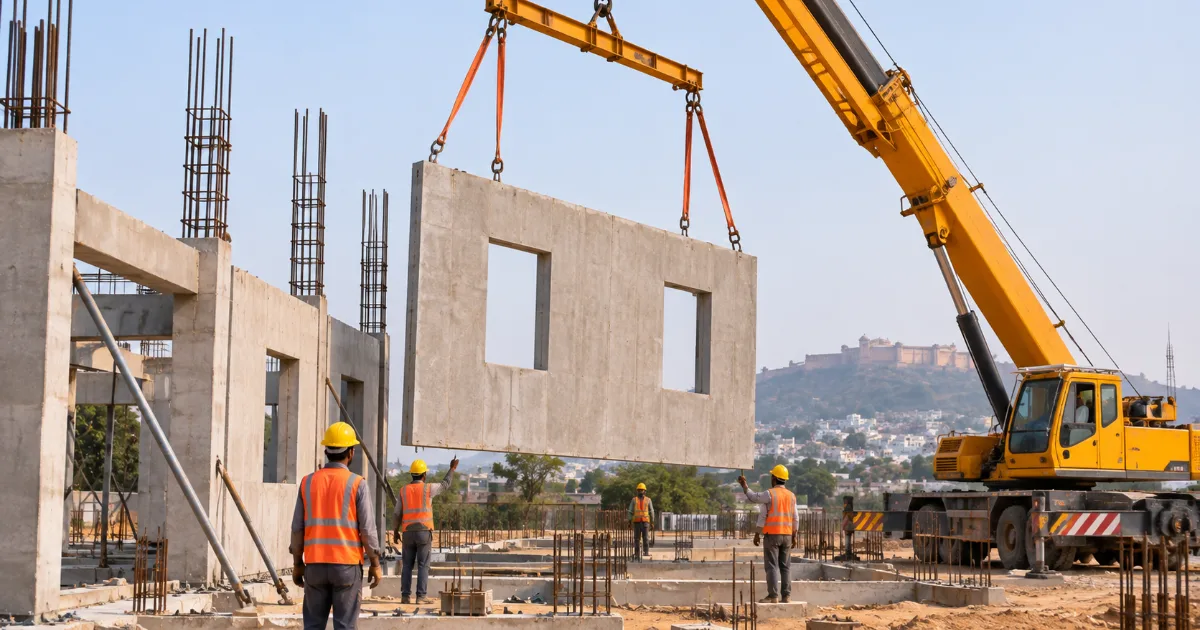
Concrete elements can be cast in their final position on site (cast-in-situ) or manufactured in a factory or casting yard and then transported and installed (precast). Both methods are used widely in buildings, bridges, boundary walls, drains and industrial structures. Choosing between them affects cost, speed, quality and site logistics.
1. Cast-in-situ concrete
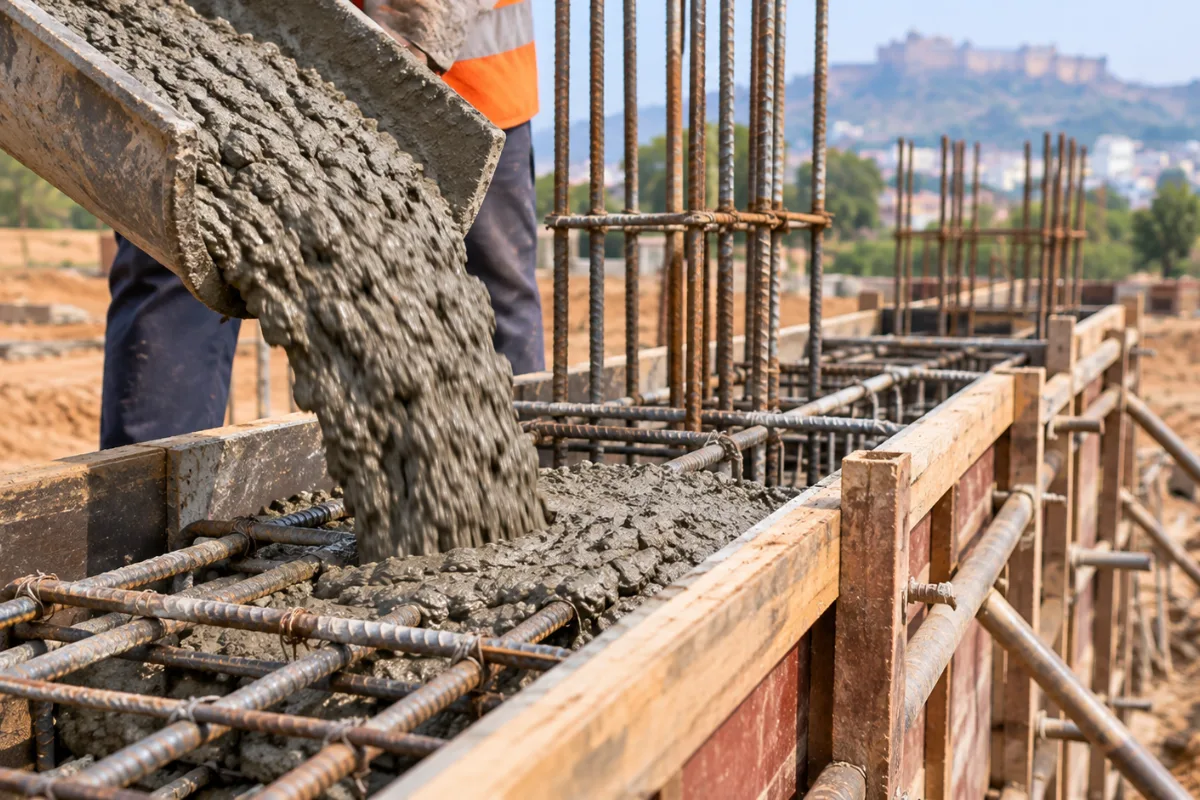
Formwork and reinforcement are erected on site, concrete is poured, compacted and cured in place. It is flexible for complex shapes, easy to modify during construction and does not need heavy cranes for installation.
- Advantages: monolithic connections, design flexibility, familiar to most contractors, suitable for small or irregular projects.
- Limitations: slower because of formwork cycles and curing, quality depends heavily on site supervision, weather affects progress, more labour and material wastage on site.
2. Precast concrete
Elements such as wall panels, beams, columns, slabs, box culverts, drains, boundary wall panels and segments are cast under controlled conditions and installed with cranes.
- Advantages: faster construction because site work and casting run in parallel, consistent quality from controlled curing and moulds, less site labour, cleaner sites and less dependence on weather.
- Limitations: needs careful design of joints and connections, cranes and access roads for transport and lifting, limits on element size and weight for transport, and higher setup cost that pays off mainly with repetition.
3. Comparison at a glance
- Speed: precast is usually faster for repetitive elements; cast-in-situ is competitive for one-off or complex elements.
- Quality: precast offers more consistent finish and strength; cast-in-situ quality depends on site practices — see our concrete quality control checklist.
- Cost: precast becomes economical with many identical units; cast-in-situ is often cheaper for small volumes.
- Site constraints: precast needs lifting and transport access; cast-in-situ needs space for formwork, materials and curing.
- Structural behaviour: cast-in-situ provides monolithic action; precast relies on well-designed connections.
4. Where each works best
- Precast: boundary walls on large plots, culverts and drains, industrial buildings with repetitive bays, housing with standard units, bridge girders and road furniture.
- Cast-in-situ: foundations, irregular buildings, water-retaining structures needing continuous construction, and small projects.
- Hybrid: many projects combine cast-in-situ foundations and cores with precast beams, slabs or walls. Pre-engineered steel buildings are another fast option — compare in our PEB vs RCC guide.
5. Practical points for precast
- Finalise design early; changes after moulds are made are expensive.
- Plan transport routes, crane positions and installation sequence.
- Specify connection details, tolerances and grouting procedures.
- Inspect elements on delivery for cracks, dimensions and lifting points.
- Coordinate with the overall schedule; see construction project scheduling.
Frequently asked questions
Is precast concrete as strong as cast-in-situ?
Yes, when designed and made properly. Factory conditions often give more consistent strength; the critical part is the design of connections.
Is precast cheaper?
It depends on repetition, transport distance and crane costs. It is usually economical for many identical elements.
Can precast be used for boundary walls?
Yes, precast panels and posts are a common, fast option for long boundary walls.
Sources
Choosing a construction method for your project? Contact ATTPL Infra.
Related reading: Comparing concrete options for your site? Read ready-mix concrete vs site-mix.



Pingback: TMT Steel Bars Selection Guide | ATTPL Infra